

Integration: Future AGI
OpenTelemetry tracing and evaluation for Haystack pipelines via traceAI.


Table of Contents
Overview
Future AGI is an open-source e2e agent engineering and optimization platform that helps you ship self-improving AI agents. The traceAI-haystack package auto-instruments Haystack pipelines and exports spans to any OTLP-compatible backend (Future AGI, Jaeger, Datadog, etc.).
Once registered, every component run, generator call, retriever query, and pipeline execution is captured as a structured OpenTelemetry span — no per-component wiring required.
Installation
pip install traceAI-haystack
For the example pipeline below, you also need:
pip install haystack-ai trafilatura
Usage
Components
This integration introduces one component:
-
The
HaystackInstrumentor: registers OpenTelemetry instrumentation on Haystack’sPipeline.run,Component.run, and generator/retriever execution paths. Onceinstrument()is called, every Haystack pipeline run produces a trace automatically.Set the
FI_API_KEYandFI_SECRET_KEYenvironment variables to authenticate with Future AGI. These code examples also require anOPENAI_API_KEY. Haystack is model-agnostic; swap the generator for any provider you prefer.
Set environment variables
import os

os.environ["OPENAI_API_KEY"] = "your-openai-api-key"
os.environ["FI_API_KEY"] = "your-futureagi-api-key"
os.environ["FI_SECRET_KEY"] = "your-futureagi-secret-key"
Register the tracer provider
from fi_instrumentation import register
from fi_instrumentation.fi_types import ProjectType

trace_provider = register(
    project_type=ProjectType.OBSERVE,
    project_name="haystack_project",
)
Instrument Haystack
from traceai_haystack import HaystackInstrumentor

HaystackInstrumentor().instrument(tracer_provider=trace_provider)
Run a Haystack pipeline
from haystack import Pipeline
from haystack.components.builders import ChatPromptBuilder
from haystack.components.converters import HTMLToDocument
from haystack.components.fetchers import LinkContentFetcher
from haystack.components.generators.chat import OpenAIChatGenerator
from haystack.dataclasses import ChatMessage

fetcher = LinkContentFetcher()
converter = HTMLToDocument()
prompt_builder = ChatPromptBuilder(
    template=[
        ChatMessage.from_user(
            "Answer the question based on the following context.\n"
            "Context: {{ documents[0].content }}\n"
            "Question: {{ query }}"
        )
    ]
)
generator = OpenAIChatGenerator(model="gpt-4o-mini")

pipeline = Pipeline()
pipeline.add_component("fetcher", fetcher)
pipeline.add_component("converter", converter)
pipeline.add_component("prompt_builder", prompt_builder)
pipeline.add_component("generator", generator)

pipeline.connect("fetcher.streams", "converter.sources")
pipeline.connect("converter.documents", "prompt_builder.documents")
pipeline.connect("prompt_builder.prompt", "generator.messages")

result = pipeline.run(
    {
        "fetcher": {"urls": ["https://haystack.deepset.ai/"]},
        "prompt_builder": {"query": "What is Haystack?"},
    }
)

print(result["generator"]["replies"][0].text)
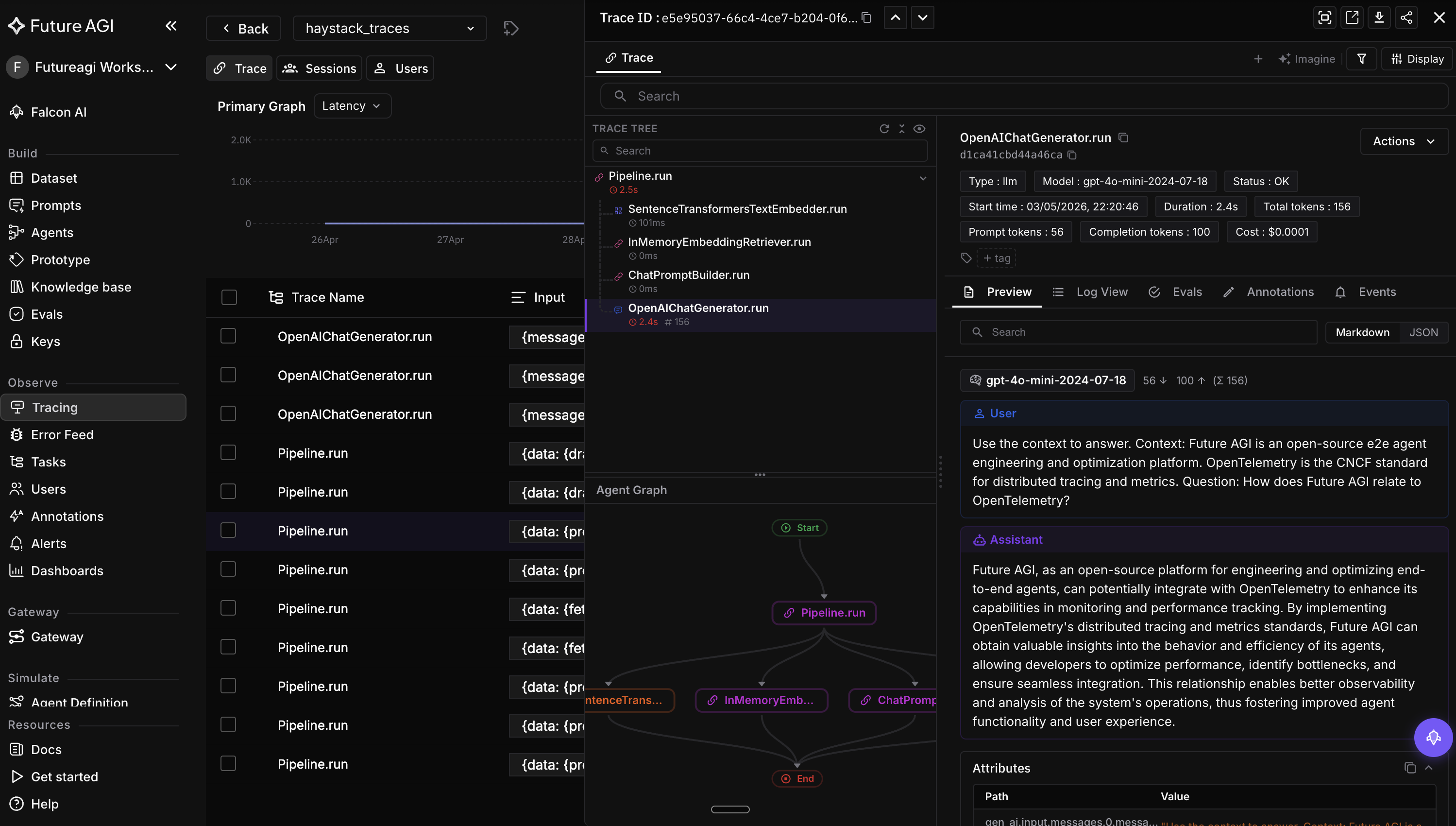
The pipeline run, every component, the LLM call, and token usage are captured as a single trace.
Resources
- Sign up at
app.futureagi.com to get your
FI_API_KEYandFI_SECRET_KEY - Full integration guide
-
traceAIon GitHub - Future AGI documentation
License
traceAI-haystack is released under the
MIT License.